The 70-20-10 Learning Model
The 70-20-10 Learning Model
Why Most Companies Misunderstand It
In learning and development conversations, few frameworks are referenced as frequently as the 70-20-10 learning model.
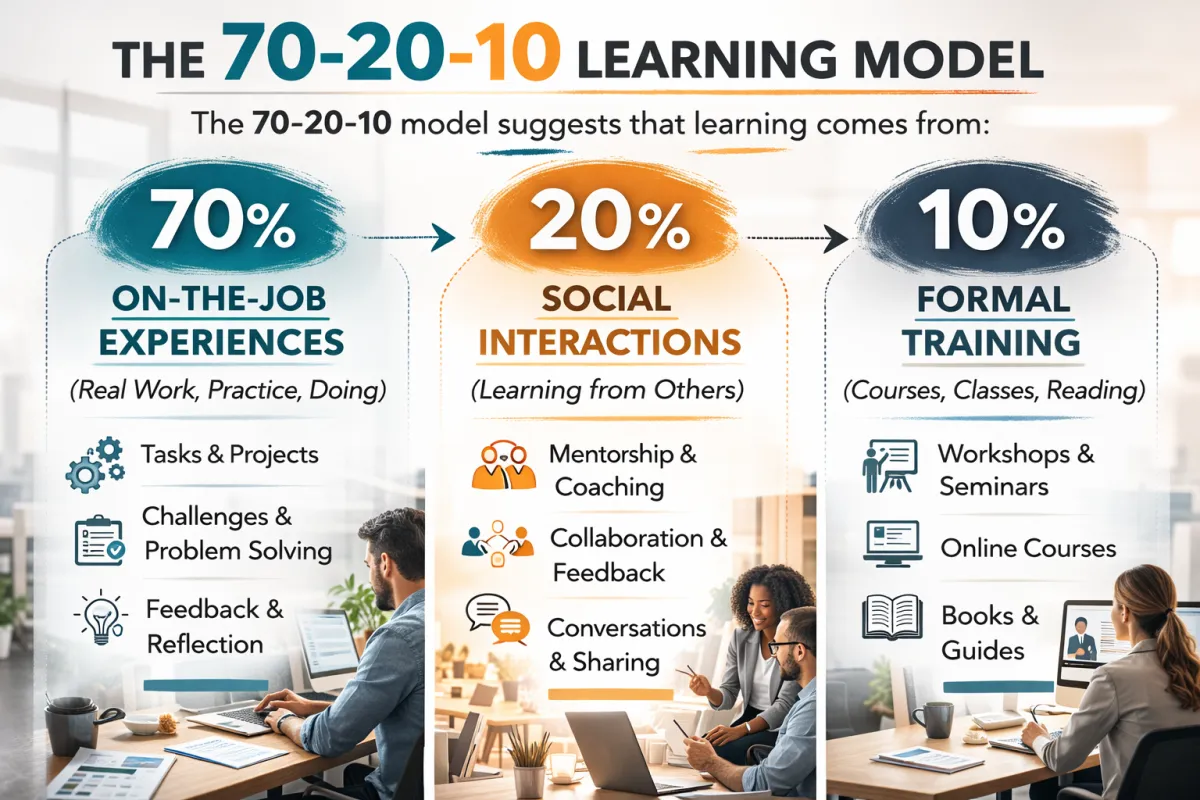
The model suggests that:
• 70 percent of learning comes from experience
• 20 percent comes from social interaction and coaching
• 10 percent comes from formal training
Many organizations use this framework when discussing workforce development strategies. However, the model is often misunderstood and sometimes applied incorrectly.
Instead of guiding thoughtful learning design, the percentages are sometimes treated as rigid formulas.
In reality, the 70-20-10 model is not a strict rule. It is a way of understanding how learning naturally occurs in the workplace.
When organizations interpret the model correctly, it can help them design more effective development systems.
Where the 70-20-10 Model Came From
The 70-20-10 framework was originally developed through research conducted by the Center for Creative Leadership in the 1990s.
Researchers examined how successful executives developed their leadership capabilities over time.
Their findings showed that most professional development occurred through experience rather than formal training.
Leaders learned by solving problems, managing projects, and navigating complex situations.
They also learned through conversations with mentors, colleagues, and managers who provided feedback and guidance.
Formal training programs still played an important role, but they represented a smaller portion of overall development.
These insights eventually became the widely recognized 70-20-10 learning model.
Why Many Organizations Misapply the Model
One of the most common mistakes organizations make is interpreting the model too literally.
Some organizations assume they should allocate their training budgets according to the percentages.
Others conclude that formal training is not important because it represents only ten percent of learning.
Both interpretations miss the purpose of the model.
The 70-20-10 framework does not suggest that formal training should be minimized. Instead, it highlights the importance of designing learning experiences that extend beyond the classroom.
Formal training provides foundational knowledge. Experiential and social learning help employees apply and refine that knowledge over time.
When these elements work together, learning becomes far more effective.
The Power of Experiential Learning
The largest portion of the 70-20-10 model focuses on experiential learning.
This type of learning occurs when employees gain knowledge and skills through real work experiences.
Examples of experiential learning include:
• managing new projects
• solving complex problems
• participating in cross-functional initiatives
• taking on stretch assignments
• experimenting with new approaches
These experiences allow employees to apply knowledge in meaningful ways while developing judgment and confidence.
Organizations that intentionally create opportunities for experiential learning often see stronger skill development than those that rely primarily on traditional training programs.
The Role of Social Learning
The second component of the 70-20-10 model emphasizes social learning.
Employees learn a great deal through conversations with colleagues, mentors, and managers.
Coaching, feedback, and collaborative problem solving all contribute to professional development.
For example, a manager who regularly provides constructive feedback helps employees refine their skills and improve performance.
Similarly, peer collaboration allows employees to share insights and learn from each other's experiences.
Organizations that encourage mentorship programs, coaching conversations, and collaborative learning environments strengthen this aspect of the model.
Why Formal Training Still Matters
Although formal training represents a smaller portion of the learning model, it remains essential.
Training programs introduce new concepts, frameworks, and best practices that employees may not encounter through experience alone.
Leadership development programs, technical skill training, and professional certification programs all play important roles in workforce capability.
However, formal training is most effective when it is connected to real work experiences and reinforced through coaching and collaboration.
Without these connections, training may remain theoretical rather than practical.
Designing Learning Systems Around the 70-20-10 Model
Organizations that successfully apply the 70-20-10 framework design learning systems that support all three components.
Training programs provide foundational knowledge and introduce new skills.
Experiential opportunities allow employees to apply those skills in real workplace situations.
Social learning through coaching and collaboration reinforces development over time.
When these elements work together, learning becomes embedded within the organization rather than limited to scheduled training sessions.
This approach leads to stronger skill development and more sustainable performance improvements.
The Role of a Training Architect
Training Architect designs learning ecosystems that integrate formal training, experiential development, and social learning.
Instead of focusing solely on course creation, a Training Architect considers how employees actually develop capabilities over time.
By aligning learning initiatives with real work experiences and leadership support, organizations can create development environments that produce lasting impact.
When applied thoughtfully, the 70-20-10 model helps organizations move beyond traditional training and build learning systems that reflect how people truly grow in their careers.