Training vs Performance Consulting
Training vs Performance Consulting
What HR and L&D Leaders Need to Know
When organizations encounter performance problems, the most common response is to create training.
Sales are declining? Launch a training program.
Customer service scores are dropping? Schedule a workshop.
A new process is introduced? Develop an e-learning module.
Training often becomes the default solution to nearly every workplace challenge. While learning and development programs can play an important role in building employee capability, training alone cannot solve most performance problems.
This is where the concept of performance consulting becomes essential.
Understanding the difference between training and performance consulting helps organizations design solutions that actually improve results.
What Training Does Well
Training is extremely effective when employees need to learn new knowledge or develop specific skills.
For example, training is valuable when:
• employees need to learn a new system or technology
• teams require product or policy knowledge
• managers need leadership development
• employees must develop communication or analytical skills
In these situations, structured learning programs can build the capabilities employees need to perform their roles effectively.
However, training assumes that performance problems are primarily caused by a lack of knowledge.
In reality, this is often not the case.
The Limits of Training
Many performance challenges in organizations are not learning problems.
Employees may already understand what they are supposed to do but still struggle to perform consistently.
This can happen for several reasons:
• unclear expectations
• inefficient processes
• poor workflow design
• lack of accountability
• inadequate tools or systems
• inconsistent leadership support
When these factors are present, training alone will not produce meaningful change.
Employees may leave the training session with new information, but the workplace environment still prevents them from performing differently.
This is why some organizations experience what can be called training fatigue. Employees attend multiple training programs without seeing any real impact on their daily work.
What Performance Consulting Does Differently
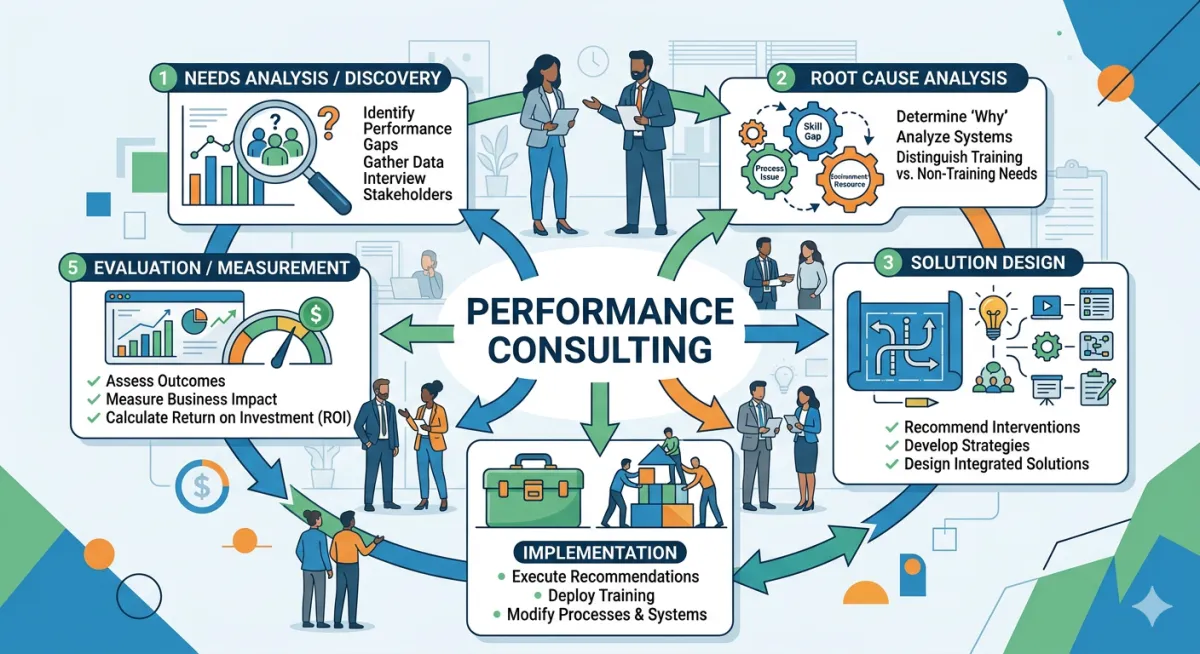
Performance consulting approaches workplace challenges from a broader perspective.
Instead of immediately asking what training should be developed, performance consultants begin by asking deeper questions about the business problem.
For example:
What specific performance outcome needs to improve?
What behaviors would lead to that outcome?
What barriers currently prevent employees from performing effectively?
This approach helps organizations identify the true root causes of performance challenges.
In some cases, training may indeed be part of the solution.
But in many cases, the solution involves other changes such as improving processes, clarifying expectations, redesigning workflows, or strengthening management coaching.
A Simple Example
Imagine a financial services firm that wants advisors to have deeper conversations with clients about long-term financial planning.
Leadership might initially request a sales training program focused on communication techniques.
However, a performance consulting approach might reveal additional issues:
Advisors may feel pressured to focus on short-term sales metrics.
Client meeting structures may not allow enough time for deeper discussions.
Managers may not be coaching advisors on relationship-building strategies.
In this situation, training alone would not solve the problem.
A more effective solution would combine training with leadership coaching, revised performance expectations, and improved meeting frameworks.
Why This Matters for HR and L&D Leaders
Learning leaders today are expected to play a strategic role in organizational performance.
Instead of functioning primarily as training providers, L&D teams increasingly act as partners who help solve business problems.
Performance consulting enables learning leaders to have more meaningful conversations with executives.
Rather than simply asking what training should be delivered, they can explore questions such as:
What capabilities does the organization need to achieve its strategy?
What behaviors drive high performance in this role?
What environmental factors support or hinder those behaviors?
These discussions elevate the role of learning from program delivery to strategic capability development.
Moving Toward a Performance Consulting Mindset
Organizations that successfully adopt performance consulting typically follow several principles.
First, they begin every learning request with a performance conversation rather than immediately designing training.
Second, they analyze the broader work environment to understand the factors influencing employee performance.
Third, they design solutions that combine learning, process improvement, leadership support, and performance measurement.
Finally, they evaluate success based on business outcomes rather than training attendance.
This mindset helps organizations ensure that learning initiatives contribute directly to organizational success.
The Role of a Training Architect
A Training Architect operates at the intersection of learning design and performance strategy.
Rather than focusing solely on course development, a Training Architect examines how learning, systems, leadership, and workflow interact to influence employee performance.
By designing learning systems that support real work, organizations can move beyond training events and build development environments that improve both capability and results.